
Deep Learning Improves Detection of Changes in Chronic Sinus Disease on CT Scans
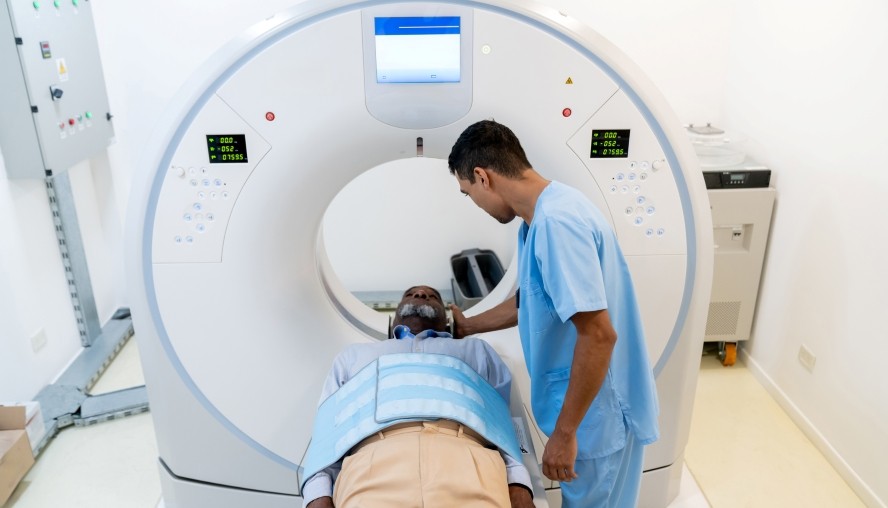 DENVER - A deep-learning tool developed to analyze sinus CT scans may provide a more sensitive way to detect treatment-related changes in patients with chronic rhinosinusitis with nasal polyps, according to new research led in part by researchers at National Jewish Health.
The study, published in the International Forum of Allergy & Rhinology, evaluated an automated deep learning-based sinus severity score, or SSS, that measures the amount of sinus opacification present on computed tomography (CT) scans. Using data from two clinical trials, researchers found that the automated method was more responsive to changes following treatment than the Lund-Mackay score, a traditional method used by clinicians to evaluate sinus disease on CT visually.
“CT imaging gives us important information about what is happening inside the sinuses, but traditional scoring methods are subjective and may not capture smaller changes over time,” said Stephen M. Humphries, PhD, a researcher in the Department of Radiology at National Jewish Health and senior author of the study. “By using deep learning to quantify disease objectively, we have the potential to measure treatment response with greater precision.”
Chronic rhinosinusitis with nasal polyps is a persistent inflammatory condition in which swelling and polyps can block the nasal passages and sinuses. CT imaging is commonly used to assess the extent of disease and is an important endpoint in clinical trials. However, the widely used Lund-Mackay scoring system requires radiologists to visually assign scores based on the degree of sinus opacification.
“These findings are important because more precise and objective imaging measurements can help researchers identify meaningful changes,” Dr. Humphries said. “That could make CT imaging an even more useful tool for evaluating new therapies and understanding how sinus disease responds to treatment.”
The researchers noted that the analysis was limited to two clinical trials evaluating a single treatment and that additional studies are needed to determine how the approach performs with other therapies and mechanisms of action.
The findings build on previous research applying automated CT analysis to chronic sinus disease, including work demonstrating the technology’s ability to detect longitudinal changes in sinus opacification in patients with cystic fibrosis.
The study was supported by AstraZeneca.
National Jewish Health is the leading respiratory hospital in the nation delivering excellence in multispecialty care and world class research. Founded in 1899 as a nonprofit hospital, National Jewish Health today is the only facility in the world dedicated exclusively to groundbreaking medical research and treatment of children and adults with respiratory, cardiac, immune and related disorders. Patients and families come to National Jewish Health from around the world to receive cutting-edge, comprehensive, coordinated care. To learn more, visit njhealth.org or the media resources page.
Media Resources
We have many faculty members, from bench scientists to clinicians, who can speak on almost any aspect of respiratory, immune, cardiac and gastrointestinal disease as well as lung cancer and basic immunology.
Media Contacts
Our team is available to arrange interviews, discuss events and story ideas.
- Jessica Berry
303.398.1082 office
303.807.9491 mobile
berryj@njhealth.org - Adam Dormuth
303.398.1002 office
970.222.5034 mobile
dormutha@njhealth.org